
Section 1 – Setting the Stage
What is Artificial Intelligence (AI)?
AI is the science of making machines think, learn, and act like humans.
It’s not about creating “robot overlords,” but about building systems that can solve problems, understand language, recognise patterns, and make decisions.
Everyday AI Examples:
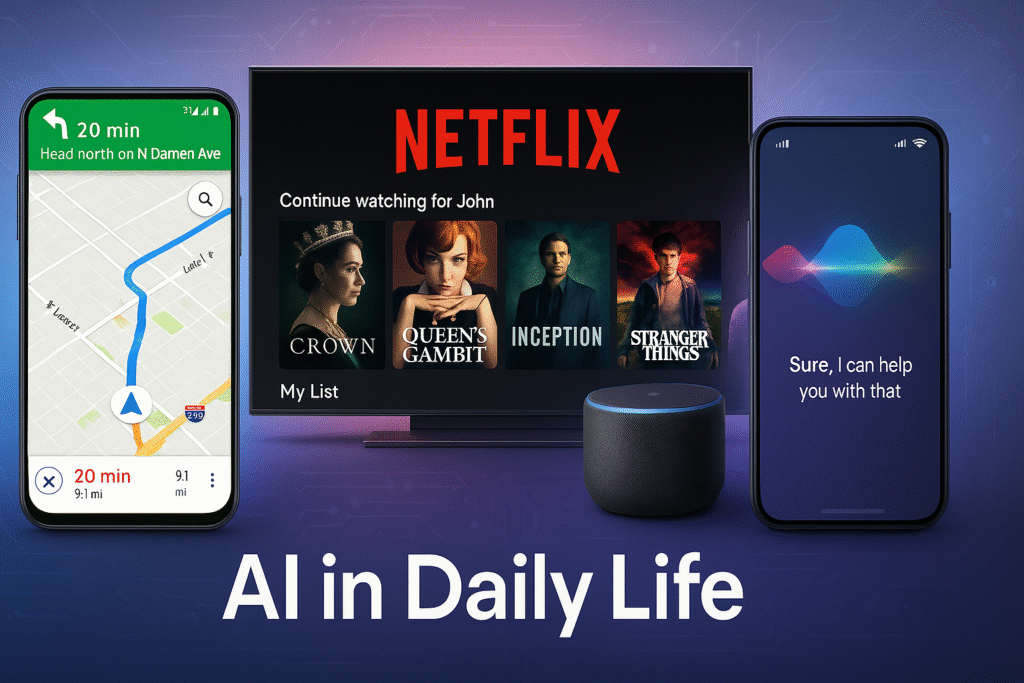
- Google Maps → Suggesting the fastest route in traffic
- Siri / Alexa → Understanding voice commands
- Netflix → Recommending shows you might like
- ChatGPT → Understanding and generating natural-sounding responses
AI is the broad field of building computer systems that can perceive, reason, learn, and act to achieve goals—often under uncertainty—without being explicitly told each step.
It includes techniques like search & planning, logic/rules, optimization, knowledge representation, robotics, and machine learning.
Example: A self-driving car perceives lanes/pedestrians (vision), plans a safe route (planning), and executes steering/braking (action) to reach a destination.
When you’d use “AI”:
- You’re designing an agent that senses the world and makes goal-directed decisions (e.g., route planners, warehouse robots, game AIs).
- You may use rules, search, or learning—ML is optional.
💡 Trivia: The term “Artificial Intelligence” was coined in 1956 at the Dartmouth Conference.
Machine Learning (ML)
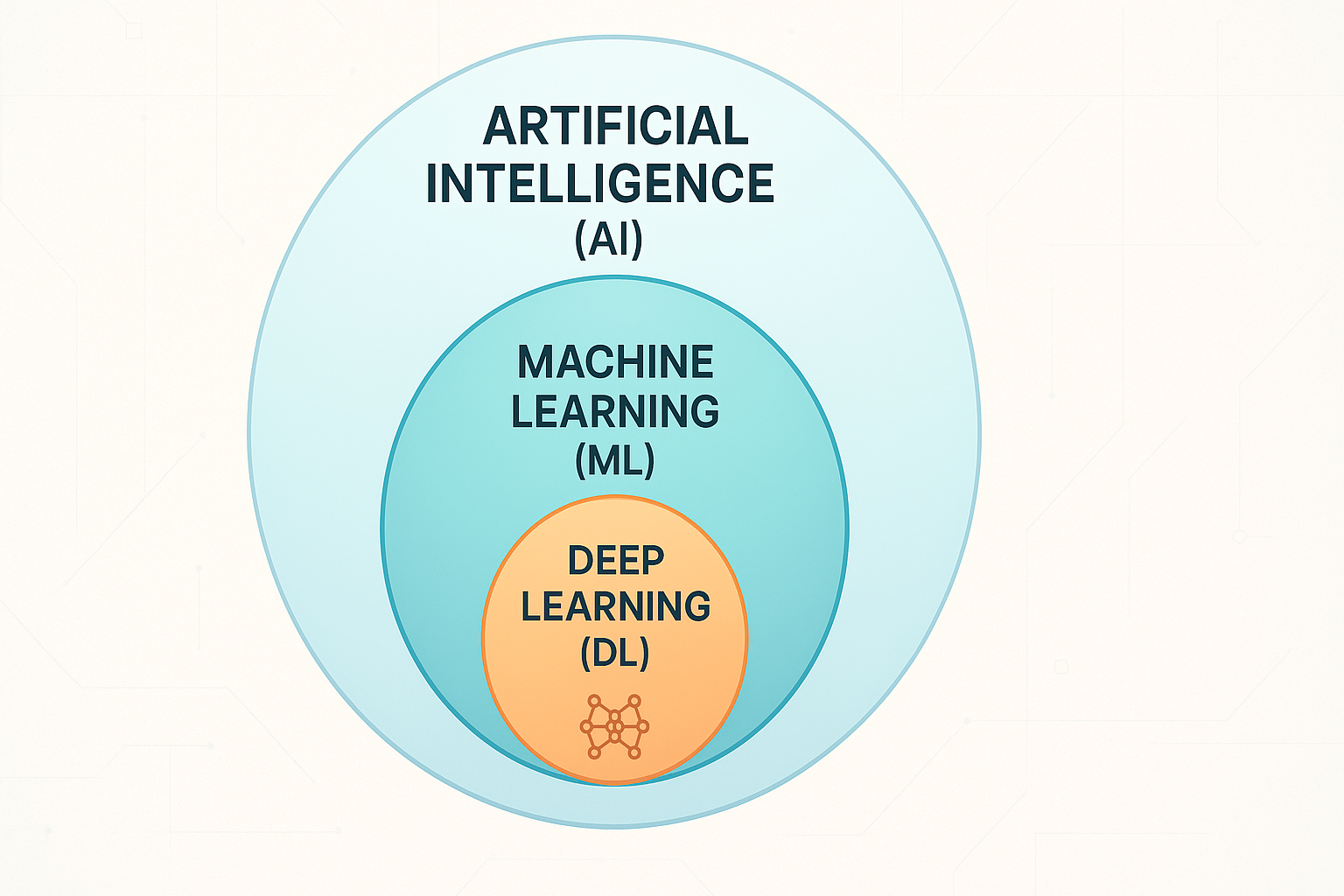
ML is a subfield of AI focused on algorithms that learn patterns from data and improve performance with experience—instead of following only hand-coded rules.
Canonical definition (Mitchell-style):
A program learns from experience (E) with respect to some task (T) and performance measure (P) if its performance at T, as measured by P, improves with E.
Plain example: An email classifier that gets better at detecting spam as it sees more labeled emails.
- T: classify emails as spam/ham
- P: accuracy/F1-score
- E: thousands of labeled emails
When you’d use “ML”:
- Rules are too messy to write (e.g., image recognition, speech).
- You have data and a metric, and you want predictions or decisions (prices, demand, risk, recommendations).
AI vs Machine Learning (ML)
| Feature | Artificial Intelligence (AI) | Machine Learning (ML) |
|---|---|---|
| Definition | Broad concept of machines doing “smart” tasks | Subset of AI that learns from data |
| Goal | Enable human-like intelligence | Enable machines to learn from experience |
| Approach | May involve rules, logic, ML, DL | Relies on algorithms & data |
| Example | Self-driving car decision-making | Training the car to detect pedestrians |
Simple Analogy:
Think of AI as “the chef” and ML as “the cooking technique”. AI is the broader art of cooking intelligent meals; ML is one way to cook them by learning from recipes (data).
Statistical ML vs Deep Learning
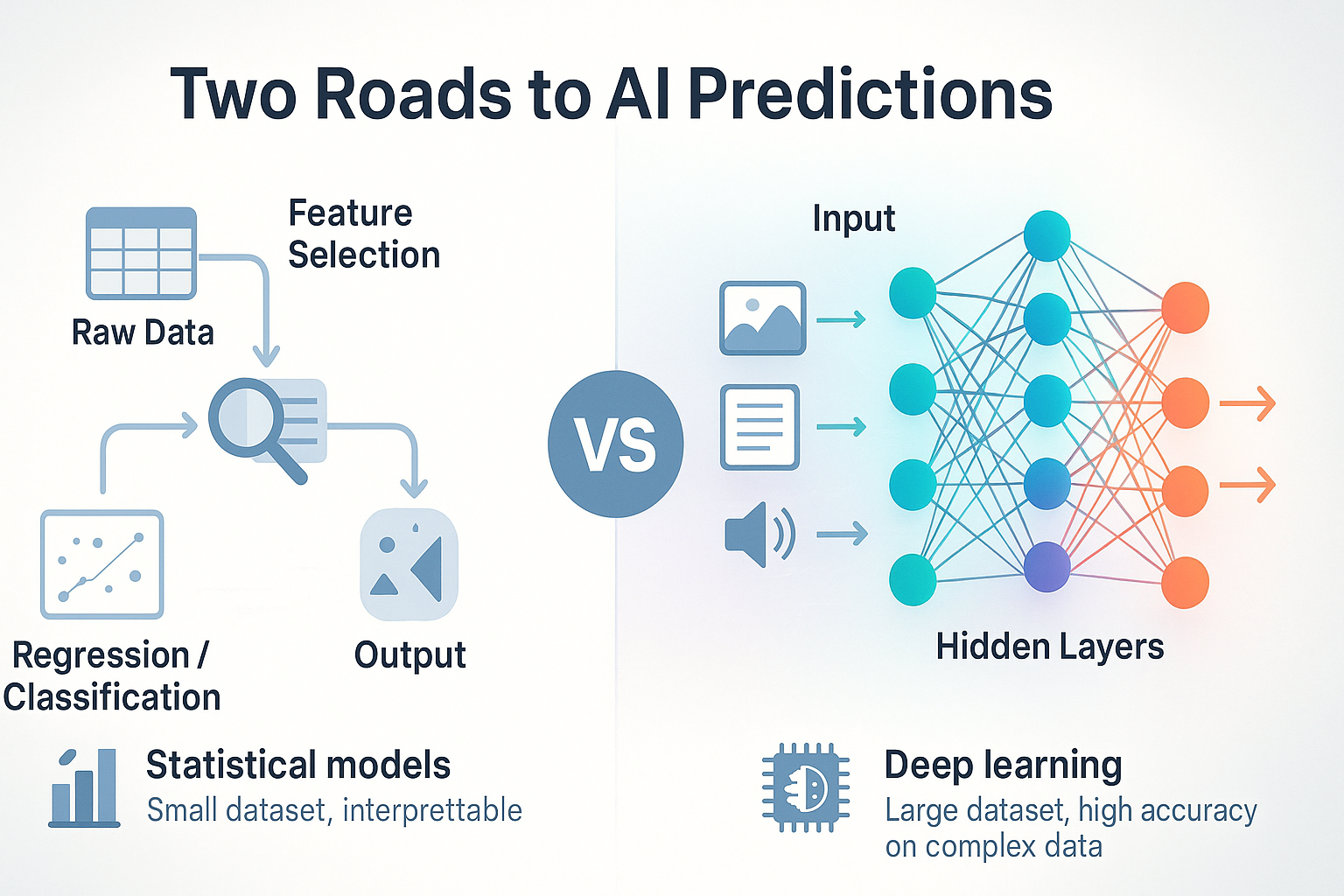
Statistical Machine Learning
- Uses mathematical models (like regression, decision trees) to make predictions
- Requires feature engineering (you decide what data points matter)
- Works well with small to medium datasets
Deep Learning
- Uses neural networks to automatically find patterns
- Handles unstructured data like images, videos, and audio
- Requires large datasets and more computing power
Example:
- Statistical ML: Predicting sales based on last year’s numbers
- Deep Learning: Automatically recognising products in images
💡 Trivia: In 2012, a deep learning model won the ImageNet challenge by a huge margin, kickstarting the AI boom.
✅ Learning Tip Box:
If you’re new to AI, start with statistical ML — it’s easier to learn and builds the foundation for understanding deep learning.